Oct 29, 2026
How to Track If Competitors Appear More Than You in AI Search Results
Your closest competitor just got a glowing recommendation. The prospect never visited a review site, never searched your brand

Introduction
Your closest competitor just got a glowing recommendation. The prospect never visited a review site, never searched your brand, and never clicked a single link that you could measure. That conversation happened entirely inside an LLM, and your analytics dashboard recorded absolutely nothing. AI search engines extract content rather than indexing it, and they can hand your next deal to a rival without generating a single referral visit. This is the zero-click competitive loss that is quietly reshaping market share across every category.
Standard web analytics are blind to this fight. When a generative engine cites a competitor, it does not trigger your referral tracking, it does not appear in your keyword rankings, and it leaves no trail in your session recordings. Market position erodes in a channel you cannot see. Most teams discover they have a problem only after their pipeline starts to dry up.
Monitoring competitor visibility in AI search answers demands a new stack, dedicated metrics, new data sources, and continuous tracking across platforms like ChatGPT, Perplexity, and Google AI Overviews. This guide walks through the step-by-step methodology to measure the gap, diagnose why competitors are winning citations, and take concrete action to recover visibility.
Key Takeaways
Competitive intelligence in AI search demands a fundamentally different set of signals from traditional SEO. These four insights define the monitoring approach.
- Share of Voice replaces rank position: The percentage of AI-generated mentions your brand commands versus competitors is the new north-star metric. It captures mindshare inside the answers prospects actually see, on the results page itself.
- AI models disagree, and that matters: A competitor can dominate ChatGPT citations while trailing badly on Perplexity or Google AI Overviews. Tracking per-model visibility reveals which audience segments you are losing, because user demographics vary substantially across platforms.
- Citation source analysis unlocks the why: 95% of citations in AI answers come from third-party websites, brand sites you don't control, Reddit, Wikipedia, news, and G2. Mapping which domains the models cite when they mention a competitor tells you exactly what assets you need to build or influence.
- Manual tracking fails above trivial scale: Daily monitoring across 50-plus prompts and five competitors generates thousands of data points each week. Automated tools with real-time monitoring and dashboard-driven alerts are the only practical option.
Step 1: Define the AI visibility metrics that reveal competitive gaps
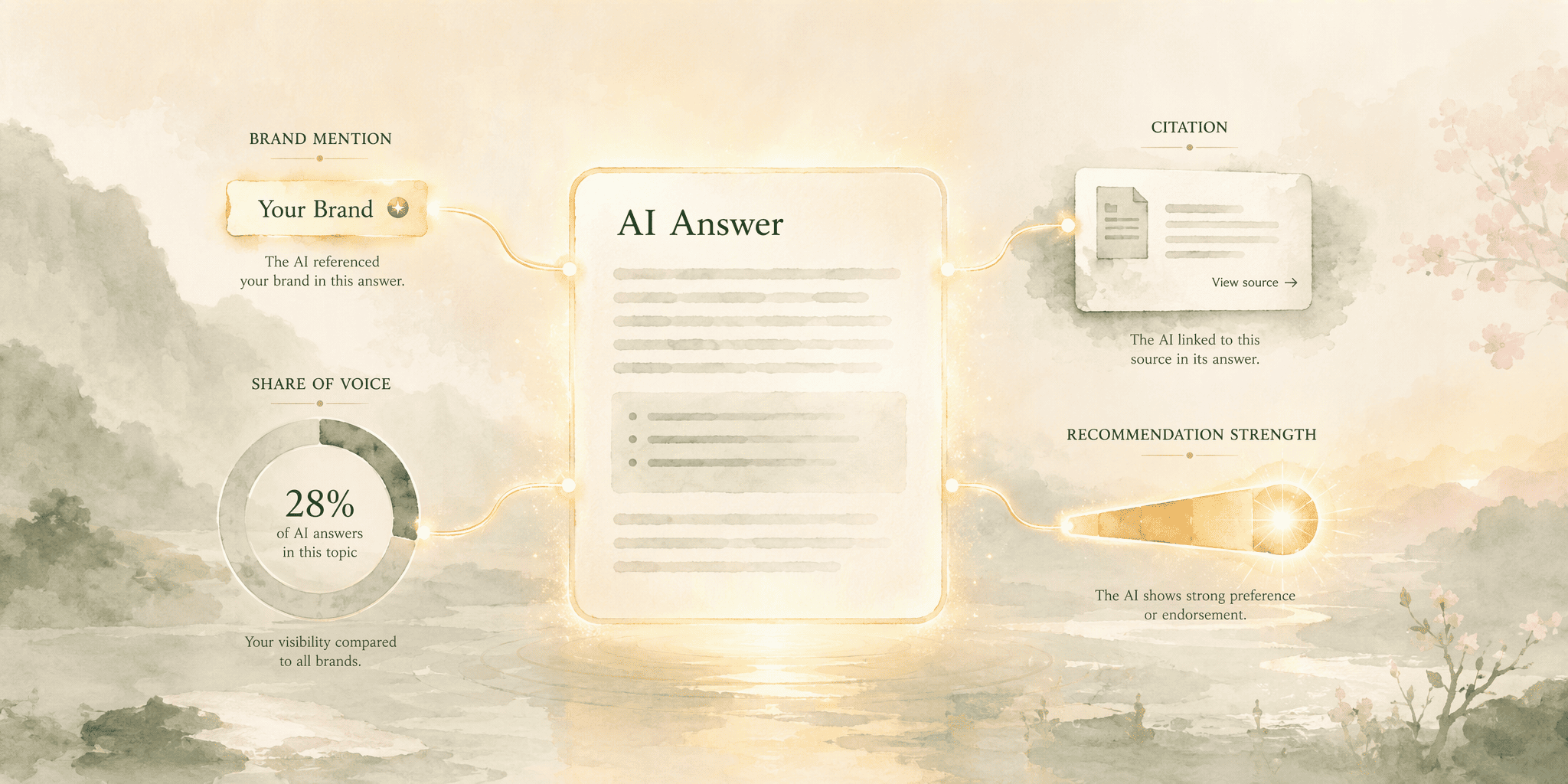
Keyword positions and click-through rates made sense when every result got a blue link and a ranking number. Generative engines give users a single answer box instead. Your page either shows up inside that box, with your brand named and your content cited, or it doesn't. The difference between "also mentioned" and "strongly endorsed" can translate into meaningful lead generation when users never click through to a website.
Share of Voice is the percentage of total brand mentions in a query set that belong to you versus your configured competitors. A platform like Siftly surfaces this across engines so you can isolate whether a visibility gap is platform-specific or systemic.
Beyond raw mention count, two supporting metrics are key. Citation Count tracks each unique URL or domain the model references when it discusses a competitor, giving you a direct map of authoritative content assets. A per-model Visibility Score, constructed from mention rate, citation presence, and ranking within answers, lets you compare head-to-head on a single engine like ChatGPT or Gemini. Academic researchers describe these as LLMetrics, and the core breakthrough is that generative engines, in contrast to traditional search engines, remove the need to navigate to websites by directly providing a precise and thorough response, potentially reducing organic traffic to websites and impacting their visibility. If you aren't measuring inside that response, you aren't measuring discovery.
Step 2: Identify which AI search platforms matter for your competitive landscape
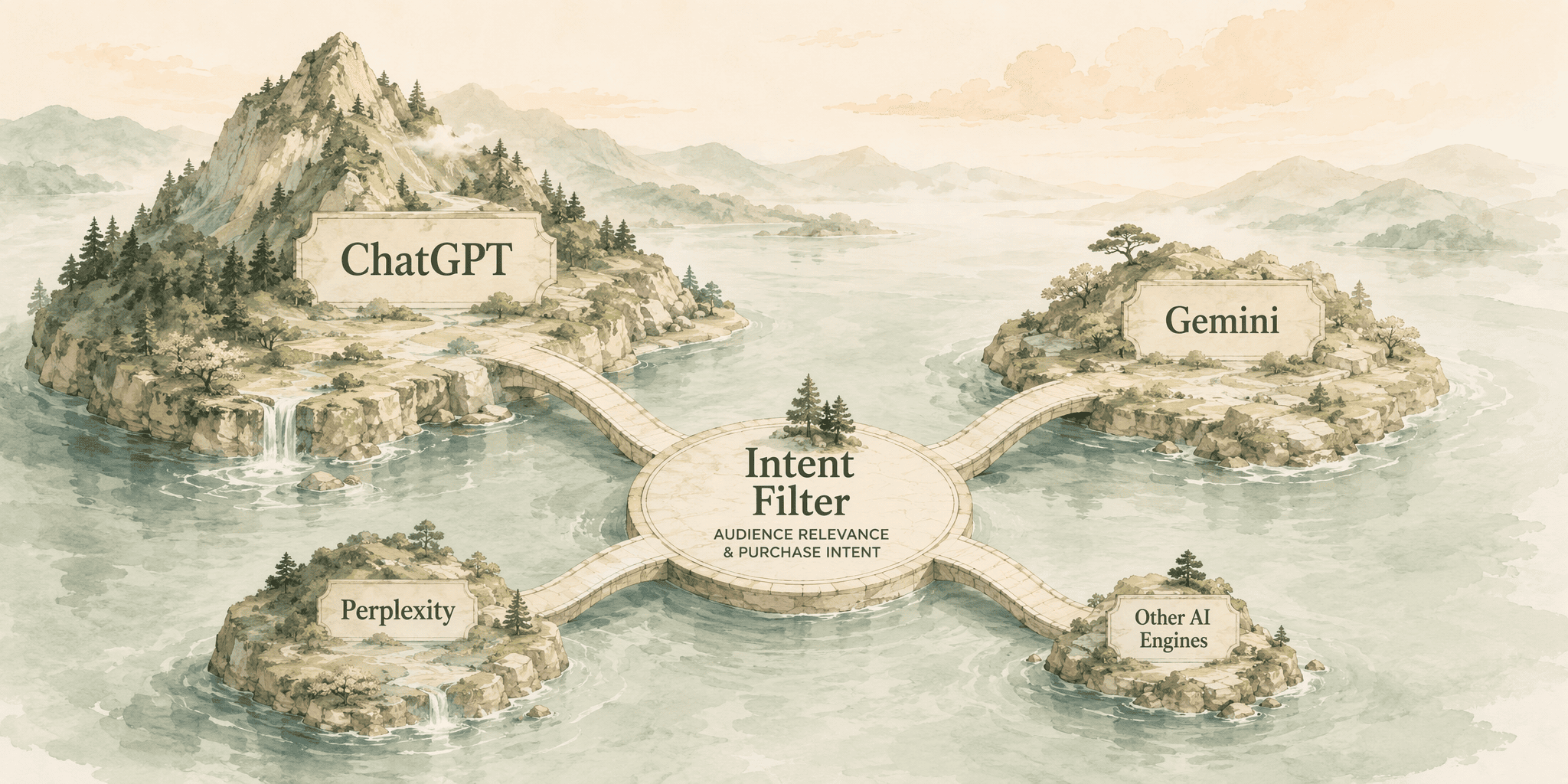
Blanket monitoring across every AI engine is wasteful. The right approach segments platforms by where your specific audience and product category actually generate purchase-intent queries. ChatGPT, for instance, now processes an additional 2.5 billion queries per day, and its user base skews toward broad consumer research and professional services comparisons. If your buyers are asking for recommendations inside conversational threads, ChatGPT is likely where you need to be measuring Share of Voice.
Perplexity’s audience behavior is distinct, it attracts a research-first user who expects citations and source transparency, making it disproportionately important for B2B software, financial services, and any category where the purchase depends on detailed evaluation. Google AI Overviews and AI Mode, by contrast, sit layered on top of the world's largest search user base, which means they shape top-of-funnel discovery across virtually every consumer category.
Segmentation lets you prioritize. You can run a side-by-side query set on the one platform that matches your buyer intent profile, then expand to secondary engines as you scale your monitoring cadence. A GEO platform like Siftly that focuses on purchase-intent conversations across ChatGPT, Perplexity, and Google AI Overviews helps isolate the detection effort to the engines where visibility loss translates most directly to lost revenue.
Step 3: Set up systematic, side-by-side comparison of brand vs. competitor visibility

A repeatable competitive comparison requires three components:
- Controlled query set: Build a query corpus of 30 to 50 prompts that represent the actual language your prospects use when they ask an LLM for a product recommendation, category comparison, or solution evaluation. Include phrasing variations: some users ask for 'the best [category] tool,' others ask for comparisons between two specific brands, and a growing segment asks for contextual advice like 'what should I use if my team is under 10 people and growing fast?'
- Fixed competitor list: Start with a narrow list of three to five direct rivals to keep the data interpretable. Each query then runs identically for your brand and every tracked competitor, with the platform logging the raw AI output. Authoritas describes this as automated query set matching, and the controlled design isolates whether a visibility gap is query-specific (certain topics where a competitor dominates) or systemic (a competitor outranks you by volume across the board).
- Capture full answer text: Capture the full answer text without relying on a binary 'mentioned' tag, which obscures whether the model cited your competitor as a primary recommendation, an also-ran in a list, or a negative counterexample. That context feeds directly into the sentiment analysis in Step 5.
Step 4: Analyze cited sources and domains to decode why competitors outrank you
When an AI model recommends a competitor, it draws from specific sources. Finding those sources is the root-cause diagnostic layer of competitive visibility analysis. Start by extracting every cited URL from your query-runs, the domains, the specific page paths, and the content format of each cited piece. What you are mapping is the citation graph the model used to construct its answer. Across your query set, patterns will emerge: a competitor may be cited because the model repeatedly references a particular industry report on Statista, a G2 category page, or a deeply-linked comparison article on a third-party review site.
AliceLabs has analyzed how the AI search engine market share landscape segments between Google vs ChatGPT vs Perplexity, noting that the citation sources each model trusts vary with its training corpus and retrieval architecture. Authority in the eyes of a generative engine is a function of frequency and contextual relevance within the model's indexed knowledge base.
What you look for are the domains that win citations across multiple queries.
Once identified, the asset gap becomes concrete. The competitor is winning because it invested in content that those specific citing domains reference. This transforms your action plan from a vague 'improve content' mandate into a targeted list of assets to build and outreach targets to engage.
Step 5: Benchmark sentiment and recommendation tone to gauge brand perception

A mention is not a recommendation. Your brand and a rival could each appear in 40% of AI answers, but if the model compares the rival favorably each time, the mention-count tie is a mirage.
Sentiment analysis layers classification onto each captured mention: positive, neutral, or negative. More importantly, it grades the recommendation force. A soft list inclusion reads like 'several options exist, including X, Y, and Z.' A strong endorsement goes further: 'X is widely considered the best choice for small teams.'
The most damaging framing is compare-and-dismiss: 'while Y offers similar features, X outperforms it on speed and pricing.' A statement like that directed at your brand actively steers the prospect away, arguably worse than being omitted entirely. LLM Pulse tracks these distinctions through automated daily query execution, letting you quantify a qualitative advantage.
For categories with high purchase-intent query volume, the distance between a strong endorsement and a neutral name-check can translate into meaningful lead-generation disparity. Siftly applies this thinking specifically to purchase-intent conversations, which means the sentiment signal it captures maps more directly to pipeline risk than a generic awareness metric would.
Step 6: Automate daily monitoring across major AI engines to track share of voice shifts
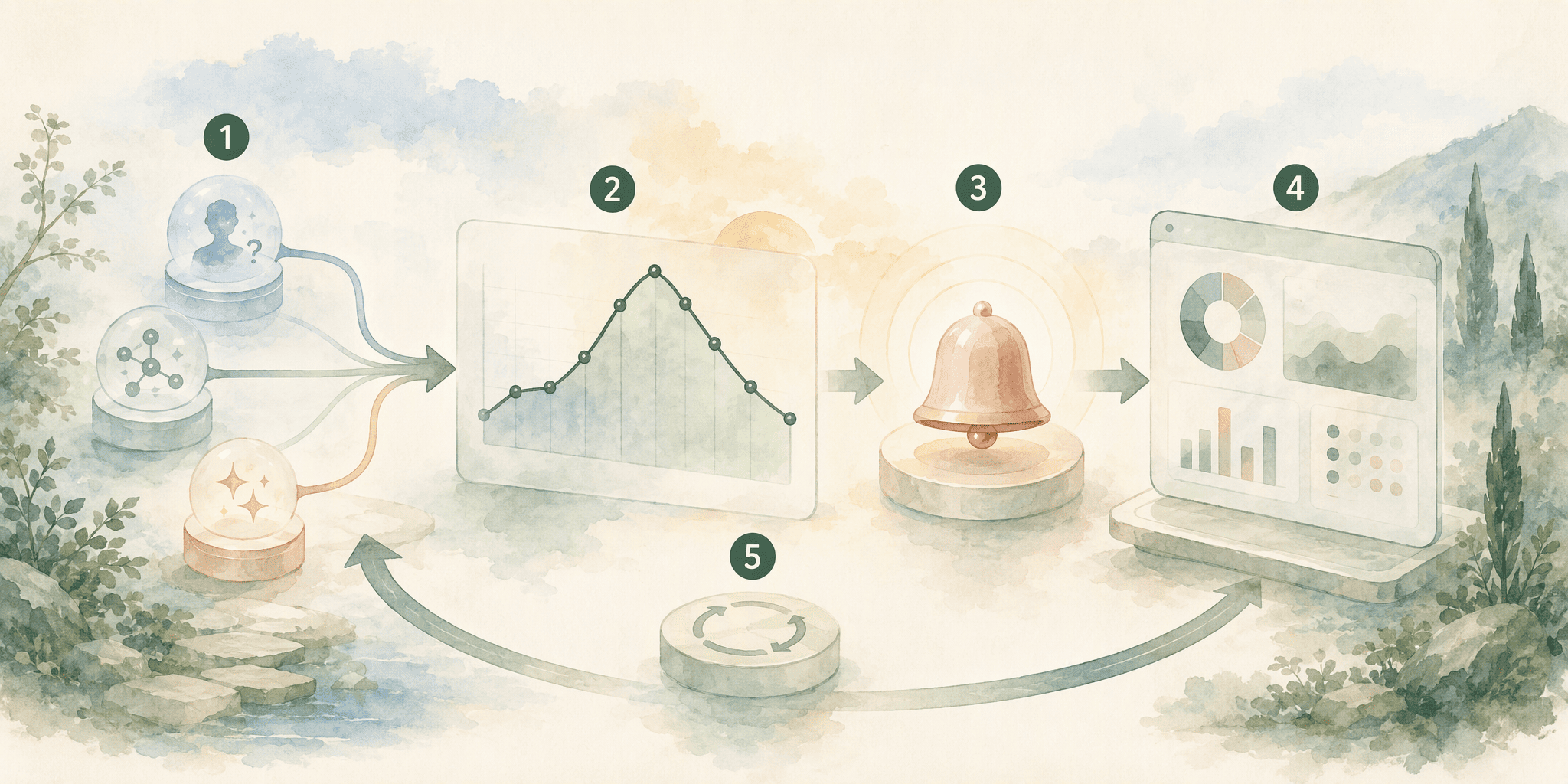
The cadence matters because AI search results are probabilistic and shift frequently. A competitor can surge on a specific model within days, often following a content update, a linked PR event, or a model retrain. A weekly manual check will miss that inflection. Daily automated monitoring gives you three capabilities that manual work cannot match.
- Configure daily queries across your chosen engine set. Most AI visibility platforms let you schedule fixed query sets to run daily against ChatGPT, Google AI Overviews, Gemini, and Perplexity. A user tracking daily visibility and share of voice metrics across these engines gets the data without maintaining a scripting pipeline.
- Pipe the output into a Share of Voice dashboard that surfaces per-model shifts. A sudden 12-point Share of Voice drop on Perplexity tied to a single query cluster tells a different operational story than a slow decline across all engines. Per-model breakout separates the signal from the noise.
- Set alert thresholds for competitor surges. When a competitor's visibility score jumps beyond a set band on a specific model and query cluster, your team receives an alert with the associated query text and the new cited sources. This collapses the detection-to-response window from weeks to hours.
Manual tracking cannot sustain this cadence. The data volume from 50 prompts across five competitors and four engines exceeds what a spreadsheet can process reliably. Automated monitoring, competitive benchmarking, and prescriptive content recommendations packaged into a single monitoring stack turns raw citation data into a competitive radar rather than an after-the-fact report.
Step 7: Turn competitive gap analysis into a concrete content and GEO action plan
Intelligence without action is trivia. The preceding steps produce a map of where a competitor outranks you, on which engines, citing which sources, and with what tone. The final step converts that map into a prioritized execution plan across four workstreams. Each workstream targets a distinct dimension of the visibility gap and carries its own investment profile.
| Workstream | What You Build | Primary Impact Metric | Investment Level |
|---|---|---|---|
| Reverse-engineer winning formats | Asset for every top-cited competitor URL, if a yearly industry data report earns 40% of citations, build a better data report with richer methodology | Citation Count on targeted domains | High effort, high durability |
| Close source-domain gaps | Outreach or guest-contribution pipeline targeting the third-party domains that feed model citations, especially the review and comparison sites | Share of Voice on key third-party citing domains | Medium effort, relationship-dependent |
| Optimize entity-authority signals | Improved author bylines, schema markup, and content structured around the entity relationships models use to answer comparison queries | Per-model Visibility Score lift | Low-to-medium effort, technical |
| Deploy GEO tactical techniques | Implement techniques from the Generative Engine Optimization playbook, cited-source inclusion, statistics enrichment, and quotation optimization, which can boost visibility by up to 40% in generative engine responses in evaluation settings | Aggregate Share of Voice across engines | Low-to-moderate effort, quickest win |
The sequencing is important. Begin with the GEO techniques because they apply to existing content assets and deliver the fastest Share of Voice lift. Simultaneously start the citation source gap analysis so that larger content-investment workstreams are informed by actual model behavior, not intuition.
Conclusion
Competitive advantage in AI search is measurable. You just need monitoring built for how generative engines actually work. Traditional analytics miss this channel entirely.
The methodology moves from defining the right metrics to platform segmentation, systematic querying, citation-source diagnosis, sentiment grading, and finally an automated cadence that feeds a concrete GEO action plan. Every step is executable with platforms available today.
The risk is not technical. It is continuing to rely on monitoring frameworks built for a search model that is already being replaced.
Frequently Asked Questions
What metrics and signals indicate a competitor is outperforming me in AI search results?
The primary signal is a competitor's Share of Voice, the percentage of AI-generated mentions within your query set that go to them. Supporting signals include higher Citation Counts on authoritative third-party domains, dominant per-model Visibility Scores (especially on high-intent engines like Perplexity), and favorable sentiment where the model endorses them over you.
Which AI search platforms should I monitor for competitor mentions?
Segment by where your buyers search. ChatGPT and Google AI Overviews cover the broadest consumer audiences and now process billions of queries daily. Perplexity skews toward research-heavy, B2B, and evaluation-intent queries. Gemini influences Google's integrated ecosystem. Start with the one matching your purchase-intent profile, then expand.
How do I systematically compare my brand's AI visibility against competitors over time?
Build a controlled query set of 30 to 50 buyer-language prompts, target three to five direct competitors, and capture the full AI response text, not just a mention flag, weekly or daily. Run the identical query set across all tracked engines. Tools that automate this prevent the bias and inconsistency of manual prompt testing.
What automated tools exist in 2026 for tracking competitor AI search presence without manual effort?
Dedicated AI visibility platforms like LLM Pulse, Siftly, Otterly, Authoritas, and AliceLabs provide automated daily query execution, Share of Voice dashboards, and competitive benchmarking. Siftly, for instance, bundles real-time monitoring with prescriptive optimization recommendations across ChatGPT, Perplexity, and Google AI Overviews.
What actionable steps can I take once I discover a competitor is cited more than my brand in AI answers?
Reverse-engineer the specific URLs the model cites for them and build superior assets in those formats. Close source-domain gaps through outreach to the review sites and data publishers feeding citations. Apply GEO techniques like cited-source inclusion, statistics enrichment, and entity-authority optimization to existing content for the fastest visibility lift.
How does share of voice in AI search differ from traditional SEO rankings and why does it matter?
Traditional rankings measure webpage position on a SERP that a user must still click. Generative engines collapse discovery into a single answer, erasing the click entirely. Share of Voice inside that answer is market share in the zero-click discovery layer. Losing here means losing deals that never generate any measurable referral traffic.
Sources
Keep exploring
More from the blog.

Oct 29, 2026
How to Track Whether Competitors Appear More Often Than You in AI Search Results
Traditional rank-checking is dead. When a prospective buyer asks ChatGPT or Perplexity a purchase question

Oct 28, 2026
7 Best Answer Engine Optimization Tools for Dominating AI Citations in 2026
You have spent months getting a page into the top three organic spots for a major keyword. The content is well optimized. Backlinks are solid.

Oct 28, 2026
9 Best Enterprise AI Search Monitoring Tools for 2026
Your executive team just asked for the ROI on AI visibility, and your legacy SERP tracker shows zero data. That moment of silence is the problem.